

For years, the data center conversation has been defined by a single anxiety: the grid cannot keep pace with accelerating demand. But the Federal Energy Regulatory Commission‘s (FERC) unanimous decision in December 2025 (EL25-49) changed the math for one of its jurisdictional regional transmission organizations (RTOs), which may be the ripple that generates a larger wave of action. By directing PJM Interconnection (PJM) to establish clear, transparent pathways for large loads, FERC rewrote the playbook for grid development in an era of explosive demand growth.
Now, the story of how the grid can prepare for incoming AI data centers feels a bit different in the new year, with the focus shifting from design to implementation. The question is no longer whether the grid can handle AI-scale demand, but how to implement innovative frameworks that deliver necessary capacity both reliably and affordably.
Leveraging flexible, co-located power as a grid asset
Co-located generation will be a critical tool for operationalizing grid flexibility at scale. Specifically, FERC’s new Interim Network Integration Transmission Service (NITS) gives PJM the direction it needs to start implementing tariff changes.
The new framework enables immediate load interconnection on a non-firm basis, with conversion to firm service once required grid upgrades are completed[1]. If curtailed due to system stress, the large load can take service directly from its co-located generation. That same co-located generation can also deliver grid services on an as-available basis, transforming what might otherwise be stranded capacity into a system-wide reliability asset.
Beyond direct co-location, strategically positioning distributed energy resources (DERs)— like battery storage and dispatchable microgrids backed by firm fuel supplies—near data centers can achieve similar speed-to-power benefits.
Powering growth today while building for tomorrow
The immediate next step is the paper hearing process, in which PJM must submit written testimony and evidence demonstrating their progress towards FERC’s directive. PJM’s filings, which are due in February, will be the first test of how the new Interim NITS and the two new Contract Demand Transmission Services (Firm and Non-Firm) will work in practice.
This can be a game changer for projects that are ready to deploy but are stuck waiting—sometimes for half a decade or more—for transmission upgrades sized to worst-case planning scenarios. The model shifts from “build then connect” to “connect while building.”
By establishing clear rules for how these large loads can safely pull power during the interim period, FERC is giving the industry a way to unlock billions in sidelined investment without compromising the long-term reliability of the grid.
Setting the bar for accelerated large-load interconnection
PJM will be the first to implement these innovative transmission services, but they may also be intended for national adoption. In October 2025, U.S. Department of Energy (DOE) Secretary Chris Wright used his authority under Section 403 of the DOE Organization Act to direct FERC to issue an Advance Notice of Proposed Rulemaking (ANOPR) on reforms to accelerate large load interconnection.
One of the ANOPR’s core principles, specifically, Principle 7, proposes a fast-tracking of large load interconnections. The proposal offered a 60-day study period for large loads that agree to be curtailable and/or dispatch their own generation facilities, at or near, the same point of interconnection.
I predict that the PJM framework—specifically the three new transmission service models —will serve as the backbone for this national standard. FERC may seek to implement these constructs nationwide with room for regional adaptation, providing much needed regulatory clarity without imposing identical rules that may not work in different markets and systems.
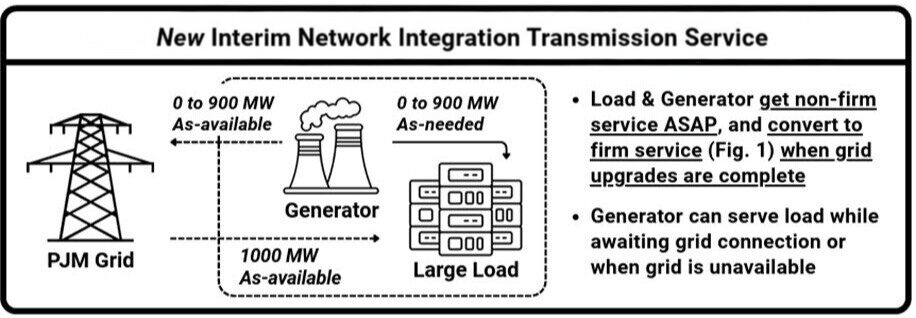
Flexible, co-located generation enables large-load connections via interim service. Onsite power covers demand during grid constraints and later transitions to firm service. (Image from Commissioner David Rosner’s concurrence in Dec. 18 Order.)
Turning policy decisions into power: Execution is key
Developers and utilities that combine the strategies of both co-locating generation with new large loads and purposely “near-locating” DERs for local grid constraints will be best positioned to move quickly. The grid is shifting toward more decentralized configurations because that’s what the current environment demands. How it scales and evolves depends on execution, but it represents meaningful progress towards mitigating a problem that wasn’t getting solved under the old model.
The energy landscape’s journey through 2026 will be about finding a balance between speed to power, ratepayer protections, and system reliability. While FERC’s December 2025 order was a victory for speed, the coming months will be the real test to prove that acceleration, affordability, and reliability can coexist. And if implemented well, they should.
This article was originally published on LinkedIn.